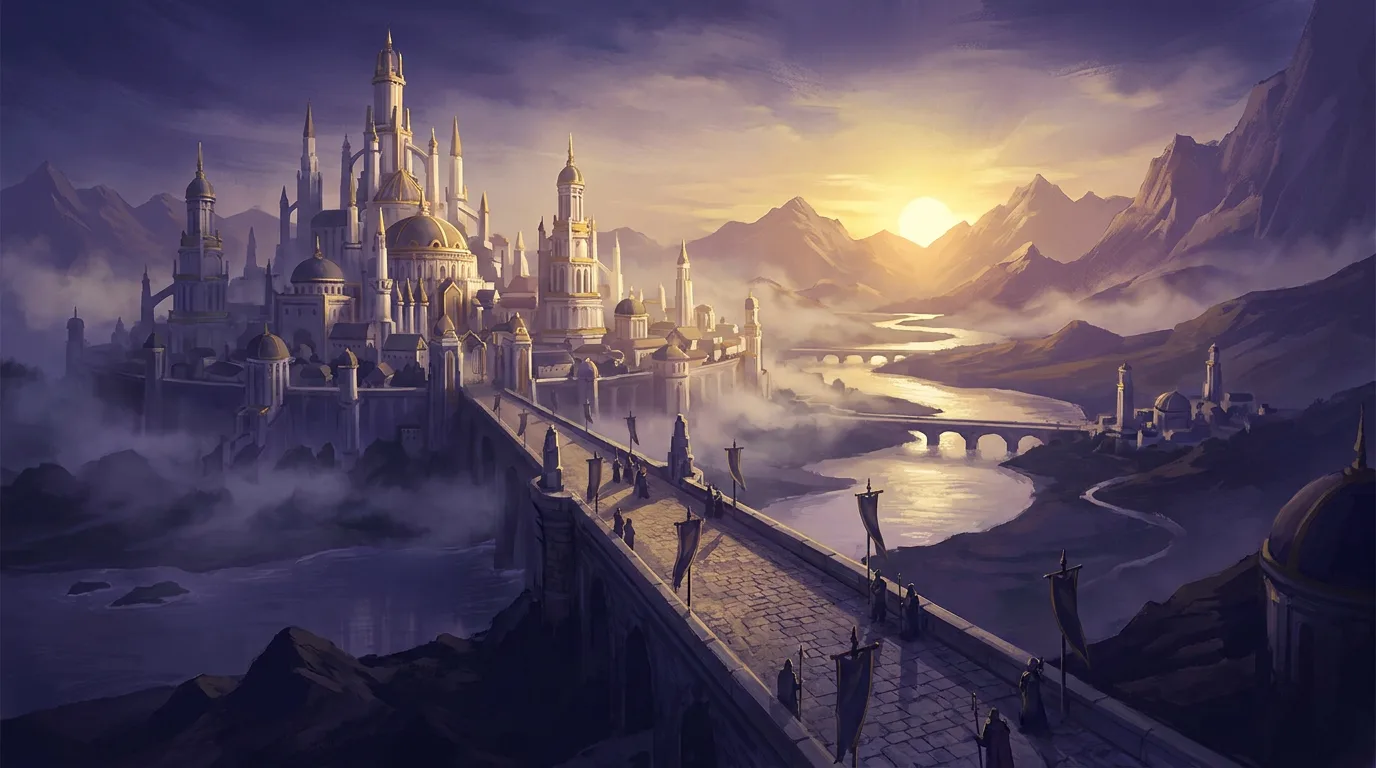
How to name cities that feel like capitals
A city name has to carry weight that a village name never does. A hamlet can be named for a duck pond; a metropolis is named by empires, merchants, and centuries, and readers can hear the difference instantly. This generator builds names the way real great cities got theirs, by fusing grand suffixes, dynastic roots, and trade-route vocabulary, and this page explains how to choose and use them well. If what you actually need is a village or a small market town, our companion town name generator works the same way at the other end of the scale.
What makes a city name feel monumental
Monumental names usually lean on one of three signals. The first is the grand suffix, and the real world offers a whole catalog of them. Greek gave us -polis, simply "city," which is why Persepolis and Constantinople (from polis by way of Greek) still sound imperial millennia later. Slavic languages built capitals with -grad, "fortified settlement," as in Novgorod and Volgograd. Persian spread -abad, "built by" or "abode of," across half of Asia, from Hyderabad to Islamabad. Germanic -burg and -haven mark fortress towns and harbors from Hamburg to Copenhagen. Borrow the pattern, not the city: Sarnopolis, Velgrad, and Tessabad read as old and important without pointing at any real place. The second signal is the founder. Real capitals are full of dynasty names, Alexandria for Alexander, Caesarea for Caesar, and an invented founder root does the same work for fiction. The third is the epithet: the honorific phrase that trails the name, like "seat of the Ivory Throne" or "gateway to the Amber Straits." Epithets are how a single line of text implies a throne room, a trade empire, or a war.
Scale is a worldbuilding decision
The fastest way to make a map feel amateur is to name a two-million-person capital like a fishing village. Decide the size of a settlement before you name it, and let the name match the scale. Cities earn heavy, compressed, history-laden names because more people have said them more times: long names wear down, honorifics accrete, and conquerors rename what they take. A good rule is that your largest cities should carry either a grand suffix, a founder's name, or an epithet, and often two of the three, while your villages stay plain and local. That contrast does silent work: when readers meet Kaedron, first city of the Twelve Legions, right after passing through a village called Milbrook, the world suddenly has a center of gravity.
Tips for maps, fiction, and games
For maps, keep capital names short enough to set in large type and distinct enough that no two major labels share a first syllable. For fiction, say the name aloud in a sentence of dialogue before committing; names with a strong stressed syllable, like Vaelora or Emperion, survive repetition. For tabletop and video game worlds, generate more names than you need and keep a bench, then reserve the epithets for places players will actually visit. An epithet is a promise of content: if the city is "tomb of a drowned empire," someone at the table is going diving.
How the generator works
Under the hood, each style owns a curated corpus of prefixes, roots, stems, grand suffixes, and epithet parts, more than two hundred components in total, plus a set of combination schemes: fused compounds like Crownspire, dynastic constructions like Aurelia Magna, sci-fi assemblies like Neo-Varek, and standalone names. A seeded random engine walks those schemes, which means the results are deterministic for a given seed. The worked examples further down this page are generated by the exact same code and verified by automated tests, so what you see is what the tool truly produces. Generate a batch, keep the two or three names that suggest a skyline, and run it again.